



Anton Velychko
Psychologist
1 500 UAH
A trauma-focused therapy using bilateral stimulation to help process and integrate distressing memories.
“Distress, traumatic events, and damaging relationships become deeply embedded in our life experience. They shape our attitude toward life and ourselves, reinforcing distorted beliefs such as “I’m to blame,” “I’m weak,” “I can’t cope,” “I’m in danger,” “I’m doomed,” “I’m unworthy of love,” or “I’m bad.” Over time, people grow accustomed to these thoughts and stop believing change is possible. The overwhelming emotions tied to distress block conscious processing, preventing the brain from naturally integrating the experience to form a healthy self-image. Psychological trauma continues to shape life, forming the foundation for many subsequent issues with health, self-perception, well-being, and behavior.
This is reminiscent of the story of an elephant tied to a post with a rope in childhood. As a calf, it lacked the strength to break free, and as an adult, it never even tried.
But these “ropes” exist in our minds! They are real, and therefore can be addressed.
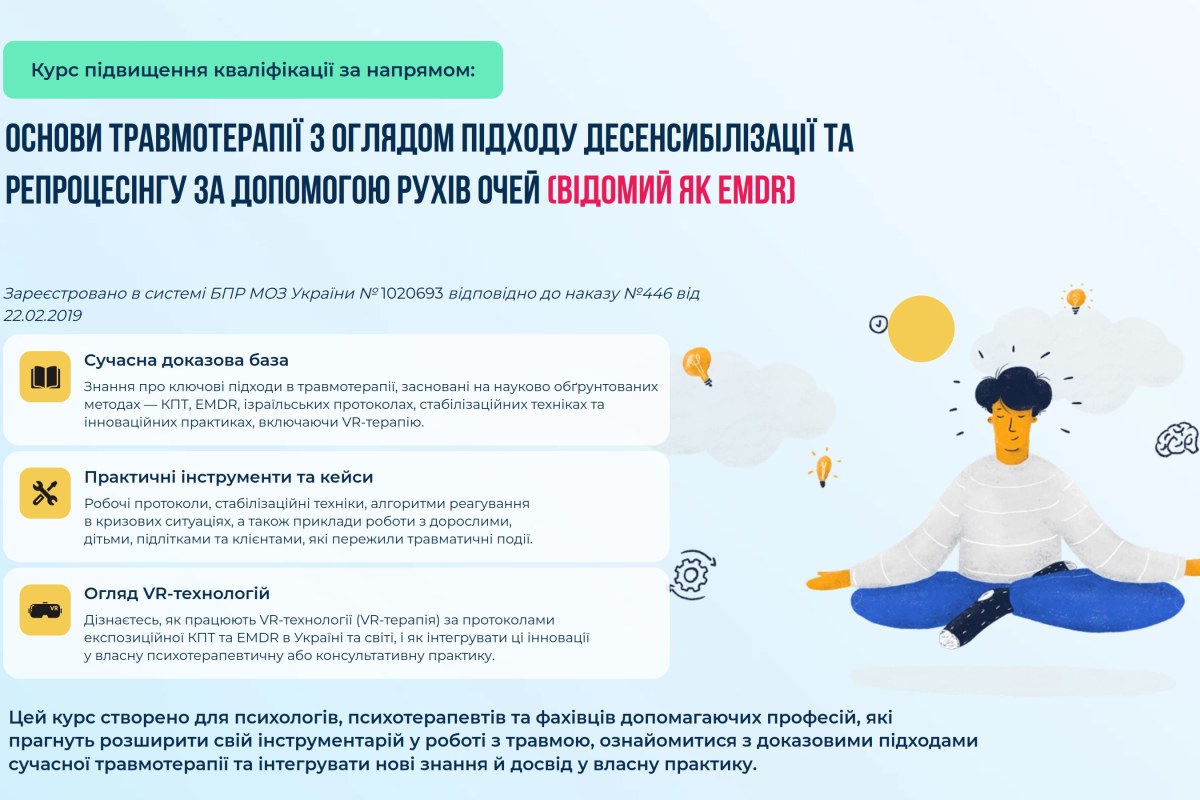
Different psychotherapeutic approaches offer varying degrees of help in such situations. EMDR combines principles from other methods while remaining a structured, technical process that sets it apart. It is not a new therapeutic paradigm but rather a modern tool for practitioners already working within traditional frameworks.
EMDR has faced significant criticism, prompting rigorous research. Today, its effectiveness is clinically proven. In 2004, the American Psychiatric Association recognized EMDR as an effective treatment for acute stress disorder and PTSD. The U.S. Department of Veterans Affairs and Department of Defense classified EMDR as a Category A treatment, recommending it as a priority method for addressing psychological trauma.
EMDR is used to address a wide range of issues, including addictions, phobias, panic disorder, childhood fears, depression, grief, adjustment disorders, dissociative disorders, oncological conditions (fears related to illness or treatment), eating disorders, and more.
The EMDR process involves reconstructing the patient’s traumatic experience. The brain “self-heals” by processing previously unintegrated traumatic material through bilateral stimulation—for example, when the therapist guides the patient’s eye movements by moving their hand horizontally from side to side.
The patient is given a direction—a light at the end of the tunnel—and selects a positive belief about themselves to work toward, such as “I survived,” “I am worthy of love,” “This is not my fault,” or “I learned a valuable lesson.”
Therapeutic benefits can sometimes be achieved in a single session. EMDR is my favorite tool, and I am grateful to my mentors, Mag. Eva Munker-Kramer and Dr. Sylvia Wintersperger from EMDR Institut Austria.
“EMDR (Eye Movement Desensitization and Reprocessing) is a therapeutic approach developed in the 1990s by Francine Shapiro. Its name reflects the core technique: eye movements used to reduce the intensity of emotional reactions to distressing memories, traumatic events, or physical ailments. The process typically unfolds as follows.
After establishing a trusting relationship, the therapist guides the client to recall and describe a troubling memory. The therapist then moves their hand rhythmically from side to side, and the client follows the movement with their eyes.
During the session, the intensity of trauma-related emotions may temporarily increase, and images may become more vivid. The therapist remains present to provide support, help the client express these emotions, and channel the released mental energy into constructive processing. By the end of the session, the emotional charge usually diminishes significantly.
After several EMDR sessions, individuals who have experienced overwhelming stress often report a marked reduction in anxiety. This is why the method is widely used worldwide for emergency psychological support in crisis zones—assisting victims of war, natural disasters, accidents, and catastrophes.
EMDR is also highly effective for addressing exam or interview anxiety, intrusive thoughts, and acute grief. For clients with severe vision impairments, a somatic or auditory version of the method is employed.
Psychologist
1 500 UAH
Psychologist

Psychologist
600 UAH

Certified Psychotherapist · Psychologist (Master)

Psychologist
2 000 UAH

Certified Psychotherapist · Clinical Psychologist · Psychologist (Master)
1 600 UAH

Psychologist
700 UAH

Psychologist
500 UAH
Psychologist

Certified Psychotherapist · Clinical Psychologist · Psychologist (Master)
2 000 UAH

Psychologist
1 400 UAH

Psychologist
1 700 UAH

Psychologist
1 500 UAH

Psychologist
1 200 UAH

Psychologist (Master)
1 250 UAH

Psychologist
1 000 UAH

Psychologist
1 500 UAH

Psychologist
1 200 UAH

Psychologist
1 500 UAH

Candidate Psychotherapist · Psychologist (Master) · Psychologist (Bachelor)
1 800 UAH

Organizer — Dr. Karsten Böhm
Organizer — UpPro School


