

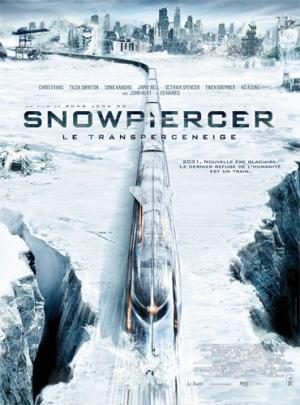
 Today, the weather outside turned into a real freezer. It’s extremely hard to do anything besides sleeping, eating, and watching movies. I was lucky—by chance, I stumbled upon Snowpiercer. At first, five details caught my attention: a Korean director (they often come up with wonderfully bizarre ideas), a post-apocalyptic setting (I love it, especially with today’s mood), Tilda Swinton as a strange, bookish overseer (no further comments needed), a train as the main character (I’m a bit of a Sheldon here), and a starkly visualized class inequality. Just imagine how delicious the result is when you mix all these ingredients together!
Essentially, the entire film is a grand, beautiful, grotesque allegory of class inequality in capitalist society. Let me explain. After chemicals were released into the air to halt global warming, the world plunged into an endless winter of brutal, hellish cold (roughly how I perceived today’s weather when I ran through Minsk in a light coat, searching for warm socks, yeah). The cold was so severe that it turned people into frozen fruit in just a couple of minutes. Consequently, nearly the entire population perished, except for the passengers of a long-distance train—a marvel of engineering launched just before the apocalypse. Over 17 years of circling the globe, a rigid class system formed inside the train: the small middle and upper classes in the front cars completely controlled the inhabitants of the economy cars, who were forced to survive in freezing conditions, filth, starvation, and violence. At some point, a group of revolutionaries decides to overthrow the dictatorship and reach the very first car, where the train’s creator resides, along the way seizing hidden resources. And there, by the way, they have showers, steaks, and much more (I won’t spoil it—it’s fascinating to watch their journey through the cars firsthand).
At the start of the film, I thought, ‘Okay, it’s cool in terms of imagination and world-building in a post-apocalyptic setting, but what new insights can it offer about revolution and inequality?’ And I was wrong. The film delves much deeper, exposing the very essence of oppressors and the oppressed, the ruling elite and the revolutionary leader, struggle and cooperation. And more broadly—how modern social ecosystems function as they are. And yes—so long as we remain within any system (whether it’s a state, a family, or a work team), we continue to uphold that system. Even when fighting the system, we remain part of it. I think this is the film’s key message.
I have plenty of impressions, but I won’t say more. You absolutely must watch it yourself. The film is truly great. And tomorrow, they’re predicting -7°C. ;)
Published on 2019-11-22 at 09:50