


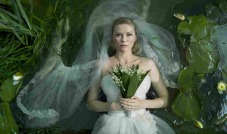
 At the beginning—slow motion—we are presented with individual images of nature,
the cosmos, and people. They are so unusual, intriguing, and interesting. Later, the unfolding events evoke mild irritation because the plot is unclear, the shots are fragmented, and the filming is wide-angle. I tried to focus and find,
to see manifestations of melancholy. Gradually, it became more interesting. In my view, the director succeeded in bringing the audience closer to the inner world of the main heroine. In reality, the film is multifaceted, and here you can explore various angles of analysis: psychiatric diagnoses, parent-child relationships, the experiences of different characters, the roles and positions of men and women, or even the objective likelihood of such a cosmic phenomenon. For me, the entire film is a symbolic reflection of the mental world of a melancholic subject—the main heroine. The events that unfold resemble a dream—fragmented shots, an unclear plotline, unusual behavior of the characters, and some fantastical planet. We will try to get closer, to feel, and to describe in words such an unfathomable world of Justine’s experiences. Here, on the surface, we have a picture of objective reality—a wedding, a certain ritual, a ceremony, guests celebrating,
behaving as they “should.” And then, as if on a bright photograph, a dark spot appears. The bride, who should have been at the center of this event, is present only physically; she seems to be behind glass, as if emotions are being drawn on the glass, but in reality, they are not real, dead, as if she is not embodied. She makes great efforts to break free from the looking glass because this is what the environment, the real world, demands, but it is only a fleeting moment. She cannot emotionally interact with the real world. For her, there is nothing in this life that could give her a sense of wholeness; she does not derive joy from her relationship with her husband or from her work, where she is considered very successful. Whenever she attempts to feel alive, the threads shown at the beginning—which she herself describes—bind her, as if sucking her back in. I associate these black, long threads with the fantastical creatures from the Harry Potter film series (the author of the series also suffered from clinical depression, by the way). Dementors—blind creatures that feed on human bright emotions and can even consume the soul. After this, a person ceases to exist as a rational being, remaining alive only as long as their body lives. That is, the subject, the Self, disappears; regression to bodily functioning, the primary process, occurs. In the film, we saw such instinctive, impulsive outbursts from Justine: during her first wedding night, she had sex in the middle of a golf course with a stranger; she showed aggression toward her boss; she fell asleep in the middle of the wedding; she took a bath when she was supposed to cut the cake. She is, in a way, a violator of the ongoing ritual, a destroyer of structure. Overall, when I recall the events that took place that wedding evening, the word “flicker” comes to mind. It is this flickering state—temporary flashes of affective fluctuations in Justine—that is conveyed through constant frame cuts. As if the world is fragmented, as if she either merges with it or finds herself on another planet, as if she does not feel it as a whole; there is no continuous line, only a series of pictures. This is the state of an infant, the boundary of mental emergence in
the objective world. However, a tense struggle is felt when her ego tries to hold on, to cling to the external world, to break free from these threads. The moment when the abstract paintings in Justine’s room change to more classical
scenes is symbolic. It reflects an attempt by the structure to preserve its integrity, to function in objective, clear reality. At that moment, she is under the affect of anger; she is tormented by this flickering of experiences, and the weak functions of her ego are still trying to manifest themselves. Justine is not the only one who “does not fit” into the ongoing event. Her mother, with her entire appearance, demonstrates her unwillingness
to be at her daughter’s wedding; she despises marriage and love. She coldly, cynically, and indifferently rejects her daughter, who came to her with her suffering. This fragment conveys what a little girl once felt and experienced when she could not even comprehend what she had lost. This moment in the film is about the loss of something that cannot even be comprehended. The maternal object exists; the child knows where it is, sees it, but cannot touch it or feel it—it is like an illusion that will never become a subject. The film so clearly presents the image of the mother. She is so emotionless, so inaccessible, like the constellation mentioned at the beginning. It is with this that the infant interacts; it is this that becomes the object of identification. Psychoanalyst André Green, describing the phenomenon of the “dead mother,” says: “The mother remained indifferent, even when reproaching the child; her gaze, tone of voice, scent, memory of tenderness—all buried. In the child’s inner reality, a hole formed in the place of the mother.” Indeed, when trying to understand what experiences Justine evokes, a fantasy arises of a house with a very beautiful facade, but inside—completely unfinished, dark, cold, and empty. Lacan also calls this inner emptiness, created
by the absence of the mother. She is a young woman with a beautiful body, but it is only a shell; as if inside, the core is broken, and it would only take a little more for the body to have no support. This is what happens in the second part of the film, when Justine is in a state of apathy, in a state where there is no meaning to life, only despair and emptiness.
The moment of losing the mother—not just a separate object but, according to Freud, the very Self—captures the incomprehensibility and power of the experience of this event through a cosmic-scale event. It is impossible to talk about it because it touches on
the primary process; it can only be conveyed symbolically. In the film, this is a cosmic metaphor. It seemed so fitting, so telling to me. Earth, as a symbol of the infant, has a planet ten times larger—Melancholia—approaching it: cold,
dangerous, and destructive, like a symbol of an emotionally absent, “dead” mother. The scene where Justine lies naked on the grass under the light of the planet Melancholia is reminiscent of the state of an infant, primordial fusion with nature. This scene
reminded me that natural Earth processes are influenced by its satellite—the Moon—and Justine is under the power of her painful, unbearable inner emptiness. But there, in the middle of the night, under the stars, she tries to feel
a connection to something otherworldly, as if filling the void. There is no doubt that the main heroine is suffering; her face, full of pain, is shown even at the beginning of the film. In her suffering, she cannot love or
hate, cannot enjoy. She experiences complete helplessness, which even physically binds her. Justine tries to convince herself that she loves her husband, that she longs for family warmth and comfort, but no, it doesn’t work. She is incapable of feeling tenderness and attachment to an object. She resorts to sensual pleasure (sex with a stranger) as a defense against the warm relationship with a subject that offers love.
It also seemed symbolic to me how all the events of the film were presented. They unfold in some remote estate, far from populated areas, where Justine’s sister lives with her family. When another celestial body approaches Earth—a global catastrophe—her sister, her husband, and her son are left alone, as if no one and nothing else exists. This can be seen as a symbol of how the melancholic object, with its affect, seems to “infect” its surroundings, which also appear to be behind the glass of reality. The moment when Melancholia collides with Earth symbolically reflects the capture of Justine’s fragile structure by a strong psychotic affect,
which destroys not only her but the system in which she exists. Before this event, she seems to be preparing for it, as she can no longer endure the mental suffering and seeks to end the struggle for survival. She accepts everything that will happen calmly, as death and numbness seem to her a release from the burden of pain and salvation of the soul.
See other movie reviews

Loveless
Andrey Zvyagintsev
"Petty Love" is an excellent psychological thriller in which the tension escalates with every frame. This film is a laureate of the Cannes Film Festiv…
Revolutionary Road
Sam Mendes
The film is set in the 1950s. The Wheelers appear to be the perfect couple in the eyes of their neighbors, acquaintances, and colleagues. She is a mod…

Songs of the Drinking
Wojciech Smoczyński
Someone left a short comment on one of the websites that could easily qualify as an absolutely concise yet completely accurate review: "The best film…