

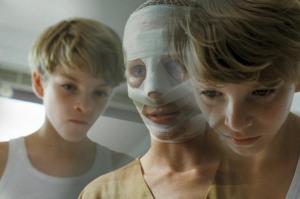
 The experimental film by Veronika Franz and Severin Fiala, Ich seh, ich seh (I See, I See, 2014), is a tragic horror about a family unable to cope with the loss of a child.
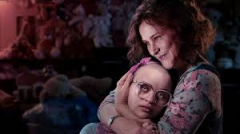
The story follows a small family of three—a mother and her twin sons—at a moment when the father leaves them, and one of the boys dies. The mother, a TV presenter named Marie-Christine, attempts to improve her appearance through facial plastic surgery, blending her inner detachment from the overwhelming events with outward alienation—from herself, her life, and her children. The family lives in an isolated cottage surrounded by a vast cornfield and breathtaking landscapes, which only heighten the contrast between the vibrant external world and the frozen internal struggles of the characters. The carefree boys, as children should be, revel in nature and each other’s company. They wander through the expansive cornfield, spend time in the forest, and swim in the lake. When the mother returns from the clinic, the children’s perception of the world begins to crack. The twins no longer recognize the woman with bandages on her face as their mother, as she has transformed from a kind and caring figure into a furious, cold, and aggressive force. We constantly witness the close bond between the twin brothers, the growing tension in their relationship with their mother, and yet we keep returning to a seemingly casual scene where, before the mother’s arrival, the boys are swimming in the lake—and one of them does not resurface. The truth for us is always somewhere in between: it’s unclear how many boys there really are. Are both Elias and Lukas present, or just one—Elias? The mother never speaks to Lukas, plays with him, or prepares his food. From then on, the twins perceive their mother as hostile, “fake,” and someone trying to separate them. This becomes a true tragedy for the boys. The plot revolves around how the brothers, bound by unbreakable psychological ties, attempt to restore their familiar reality, inviting their mother into it. But instead of hearing their “call,” she is frightened by it and responds with even more radical actions—punishments and outright violence. The mother and the boys become warring factions.
The children’s patience reaches a breaking point, culminating in denial and outright rejection of their mother. To them, she has become a monster who, in some incomprehensible way, has invaded their home, dressed in their mother’s clothes, and is pretending to be her. The bandages on her face, her terrifying behavior, and sudden flashbacks completely shatter the fragile psyches of the children. The only way to find out where their real mother is—to uncover the truth and force the impostor to speak—is to extract the information by any means necessary, even if it means protecting themselves from the monster. The children’s love is so desperate and all-consuming that all prohibitions vanish, along with their immense fear of confronting the horrifying reality. They must find their mother at any cost, even if it means destroying the monster in bandages.
The scenes of the boys’ violence against their mother are filmed with unsettling detachment. Their absurdity, yet profound heartbreaking tenderness, cannot fail to move the viewer. The mother had a chance to survive. Driven by the fear of death, she accepts all the twins’ rules, allows them to play together, and promises to care for Lukas as before. But everything is undone by a simple question from the surviving boy, Elias. He asks a straightforward question to test her sincerity—where is Lukas now, and what is he doing? In the frame, we see Lukas nearby, holding a candle. “I don’t see Lukas,” the exhausted, bloodied, and barely speaking mother replies. “Only you can see him.” Elias bitterly retorts, “If you were truly our mother, you would see Lukas right now.” The house then bursts into flames. The boys set it ablaze, burning their mother inside. They themselves enter another realm—one where they once played as children, before the tragedy occurred, when everyone was still alive. There, in the vast cornfield, they are greeted by their mother—real, gentle, smiling, and loving both of them.
One could ponder the plot, the characters, the ways of processing trauma, and the methods of establishing contact for a long time. But to me, this film feels like a metaphor. It’s about how death, when it arrives, changes people so profoundly that they can no longer stay together. Sometimes, one must endure yet another great tragedy, or even another death, to part ways. And in such moments, neither love, nor attachment, nor common sense can heal. Nor, as we see, can remote therapy, which the mother turns to. One is reminded of the cliché: “Time doesn’t heal; phenazepam does.” And I would add: people heal too—with their words, their emotional presence. From the plot, it’s clear that the family did not receive proper help from mental health professionals. Nor was there a single person from the outside who could offer assistance or emotional support. To me, this film is about how dangerous it is to face one’s grief alone. It’s about how one can overestimate their own abilities, even if they were once the best mother in the world. It’s also about the right to let the living decide for themselves what kind of relationship they want to maintain with the dead. If they refuse to believe in death, if they insist on seeing the deceased as still alive, if what we call a hallucination is the glue holding the world of the living together from collapsing—why not allow it? The world is layered and diverse, even in the most difficult times for a person. And if I love someone, I will always find a way to shout it to the world. If only the world would listen.”