

Realism is such a strong, tenacious, huge, eternally hungry monster...
Yevhen Volobuyev-Senior

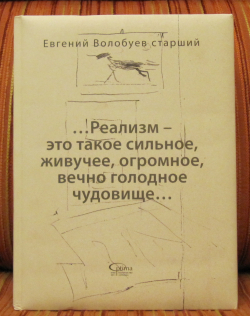 In the foreword to this book, the daughter of the renowned Ukrainian artist Yevhen Volobuiev Sr., Natalia Volobuieva, writes that some pages may only be understandable to artists. But for the most part, the book is about the connection between an artist's creativity and their personality.
Throughout the memoirs, notes, sketches, correspondence, and even denunciations, the reader has the opportunity to peer into the world of another person. Another person in the deepest sense. A person whose mindset sharply differs from that of "ordinary" people. Someone who sees connections and feels associations according to different laws.
Slow reading helps to discern what weaves the fabric of the artist's world. Gazing into another person's world does not tolerate haste.
During his studies, the protagonist is completely immersed in developing the gift of transferring onto canvas what he feels and sees with his inner eye. As he writes in a letter to his future wife, "You must absolutely see the image already ready on the canvas and then paint it... And if there is no image in your mind, then there is no image on the canvas, no matter how closely you approach nature" (p.). This approach is likely to be unusual for those without an artist's mindset, who believe that drawing from nature is simply an accurate transfer of what is before them. A psychologist might say, what a wonderful metaphor for creating one's own life! First, you truly need to "see the image already ready." Then bring it to life.
In such a focused state, which consumes the entire personality, manifestations of surrounding life unrelated to the subject of focus become obstacles. They irritate, "something is always hanging over your head. I don’t need any entertainment. I would just like to paint, not show it to anyone, not argue with anyone" (p.).
It is difficult to interact with a person in such a state. They do not need conventional or even intimate contact. The only format of interaction they can allow is one strictly on their terms. Continuing or interrupting it is only up to them.
Thus, a creator of beautiful paintings, filled with tenderness and interest in people, can be unbearable, sometimes offensive in everyday life, to their loved ones.
Therefore, for those who tie their life to an artist, it would be wise to realize that their first love is not you, but their work. There is no point in taking offense, demanding more attention, or planning to "remake" anything. It is better to make the decision to be together or not "on the shore."
His children, wife, and Yevhen Volobuiev Sr. himself admitted that in his "love ranking," painting was always in first place. Everything (and everyone) else came second or further down.
Volobuiev Sr.'s powerful and unique talent was noticed even in his youth. His judgments—uncompromising and not always flawless—carried great weight among those around him. Once, he told his wife’s sister (all three studied together and rented one studio) that she would never become a painter. The artist stopped working for about six months. She only started painting again after renting her own studio. This was the globally renowned artist today, Tatiana Yablonskaya.
His wife, Olena Yablonska, did not paint for twenty-five years. As the compiler of the book, Natalia Volobuieva, writes, her mother spent twenty-five years looking at everything through her husband’s eyes. Only after a quarter of a century was the artist able to overcome the influence of Volobuiev Sr.’s personality and pick up her brushes again.
Living in the Soviet Union in the first half of the twentieth century, the protagonist manages to remain apolitical. He is only interested in painting. The inability to paint is experienced as true torment. Military service, war, captivity, and a prisoner-of-war camp are double the stress for the artist. From the restrictions unnatural for a creative person and from the inability to paint. Thus, Yevhen Volobuiev experiences army life: "...How imperceptibly you sink into this life. You stop thinking. You stop dreaming. You grow dull, everything becomes indifferent. I notice this. Gradually, everything will be knocked out of your head. And only when you escape from here can you appreciate free life, return to a normal state. It’s as if they are twisting your joints, bending you in every direction, trying to make you into something like a street acrobat from the past. How monstrous, painful, and unnatural everything is here" (p.).
When there is something worth living for, a person can survive and preserve themselves. Viktor Frankl proved this on his own experience, having survived a concentration camp during the same war that Yevhen Volobuiev Sr. fought in.
The artist’s inner core—the thirst for painting—prevents him from breaking. In letters to his wife (whom he had not seen for five years since their marriage (!)), he plans a future happy family life. With one phrase, like a precise brushstroke, he "paints" an entire textbook on family life. "It seems to me that people are unhappy because they imagine life not as it is, but as they would like it to be" (p.).
His apolitical stance and immersion in art save the artist from the influence of propaganda. But they cannot save him from the consequences of successful manipulation (which propaganda uses). After an exhibition of his works in 1968 (1968, not in ’37, not in ’53!), letters of outrage were sent to the Central Committee of the Communist Party of Ukraine. They complained that where were the artist’s paintings depicting collective farm labor, with cheerful, beautiful girls in the fields?! An old, exhausted woman from hard labor—this was slander against Soviet reality! "What are Volobuiev’s ‘masterpieces’ calling for?" (p.).
For the authors, writing not to the exhibition organizers, not even to the Union of Artists, but to party organs, is normal. The authors genuinely believe that the image propagated by films about collective farm labor is the truth. A "poster-like" perception of painting has formed among the general public. Only a specific call, only a specific situation. The question in the denunciation letter, "what are they calling for," is an unconscious substitution of concepts. Because this phrase makes sense when talking about poster art, not all art. In this case, we are faced with the artist’s vision. When only "the essence of experiences" remains (p.).
Toward the end of his life, summing up his life, Yevhen Volobuiev Sr. admits that he "always sacrificed everything" (p.) for the sake of being able to paint. Because he was drawn to painting by a force he could not overcome.
The artist regrets that he paid too little attention to his wife and children, that he missed out on many interesting things, even love. But if he were to live his life again, he would live it the same way. It doesn’t depend on the level of talent. "The main thing is that I cannot live any other way" (p.).