

Elizabeth Strout. A woman with a law degree and a writer’s talent, which, fortunately, was not stifled by the legal profession. A Pulitzer Prize winner in 2009. Unfortunately, her name is almost unknown here. Even my American friends had never heard of her. Recently, I had the chance to read two of her books at once, and I can confidently say that they were the best examples of modern literature I’ve come across in recent years. I read them as voraciously as I used to, unable to put them down, eager to find out what would happen next. Their characters and stories still linger with me even now, after finishing the books.
«Abide with Me» (Пребудь со мной). The story of young priest Tyler Caskey and his family, along with the entire provincial America of the late 1950s. I think all small towns are alike around the world and across all eras. A community that can support, uplift, or condemn and crush. A closed system with its own rules, customs, leaders, and outcasts. Mandatory Sunday church attendance. In the countryside, the church is more than just a place of worship and God—it’s an opportunity to show off a new hat, demonstrate culinary talent, exchange news, handle business matters, and host a small celebration after the sermon, whether it’s a meal or tea, which adds bright colors to the grayness of everyday life. And so, the priest in such a parish is much more than just a priest. He’s a psychologist, a kind of legislator of public opinion, a soul-searcher, and a dealmaker. He’s also a member of the community who can be elevated to a leadership role or ruthlessly cast down from the pedestal.
Yes, Tyler Caskey is young. He receives the West Ennet parish assignment right after seminary and moves into a modest, run-down house provided by the parish, along with his wife and young daughter. It must be said that the West Ennet parish itself was not wealthy, and Tyler was chosen as its pastor precisely for his modesty and asceticism. The cathedral commission responsible for parish assignments was more than confident that Tyler Caskey would never complain or ask for money. Like all small, closed communities, the West Ennet congregation viewed the new pastor with caution. The objects of close scrutiny and gossip also became the new pastor’s wife and daughter. Indeed, Lorraine Caskey was slightly more beautiful, slightly more free-spirited, and slightly more extravagant than expected of a pastor’s wife. She might have been an outcast, but Tyler himself was so sincere in his faith, his simplicity, and his desire to honestly bear the burdens of life that the community quickly grew to love him. And so, they also covered his wife—so unsuited to him—with the blanket of their love.
But then misfortune strikes the priest’s family. Lorraine gives birth to a second daughter and soon falls ill with cancer. She fades quickly, painfully, and, most importantly, hopelessly. And here, the author raises a topic that is so controversial for society: euthanasia. Of course, in the late 1950s, this practice did not yet exist. Or rather, before World War II, euthanasia was practiced in many European countries. However, after the war—and especially after the actions of the Nazis—this concept and, even more so, the practice were banned for a long time.
One day, unable to bear his wife’s suffering, Tyler leaves a vial of morphine by her bedside. The author does not explicitly state whether Lorraine used the vial or passed away naturally when her time came, but what matters is Tyler’s decision to do so. The very idea of suicide is strongly at odds with religion, but religion is carried out by people—they are mortal, weak, and suffer. And a priest, like any other person, can be unable to endure suffering.
In any case, Lorraine dies. The parish sympathizes deeply with Tyler and offers support, but a new tragedy looms: his eldest daughter, Katherine, unable to cope with the loss of her mother, falls into trauma and becomes, in essence, a “Rain Man”—she stops speaking, lashes out, and does many other unbearable things.
And here, as a psychologist, I tip my hat to the author. How accurately, without unnecessary sentimentality, yet so grippingly, Elizabeth Strout describes a child’s development of trauma. The mother is dead, the father is consumed by grief, the grandmother and aunt are preoccupied with the newborn, and the 6- or 7-year-old child is left alone with her grief. She sinks deeper and deeper into it, screaming for help in the only way a child can—by worsening her behavior. But the adults either ignore her, punish her, or react with indignation. The schoolteacher Mary Ingersoll particularly excels in “indignation” and “punishment.” She complains about Katherine during Sunday tea gatherings among the women of the community, she complains to Tyler, and she complains to the school principal, as if this child were the embodiment of all evil on earth, rather than a little girl trapped in her grief. There’s also Rhonda Skilling, a self-proclaimed expert in Freudian theories. It must be noted that Freud and his theories on sexuality were—and still are—“too much” for puritanical provincial America. However, when delivered by a young, attractive, “communist and athlete” woman, some aspects of his theories can even be listened to, especially if you don’t listen too closely. That’s why Rhonda is brought in to “help” Katherine. Deliberately, I’ve put “help” in quotes because all her assistance boils down to a lecture on the basics of psychoanalysis delivered to Tyler Caskey.
The book also features other deeply psychological characters. For example, Charlie Austin, a secondary character, as they say in film. A war veteran suffering from post-traumatic stress disorder. If Charlie had been a veteran of any other war after World War II, he might have received a proper diagnosis and help. But not in the 1950s, so he carries his trauma and pain alone. Or does he? Charlie has a wife and children. They endure the full brunt of PTSD together.
But it’s no coincidence that it’s Charlie, another trauma survivor, who pulls Tyler Caskey—also drowning in grief—out of his despair, almost literally dragging him back from the depths.
The book also features Tyler Caskey’s housekeeper, Connie Hatch, who is also a thief and a murderer. But is she really so terrible or evil?
There are many other secondary but vivid characters who, like pieces of a mosaic, intersect, intertwine, and create the remarkable plot of an extraordinary book—one that is far richer, subtler, and more multifaceted than this review.
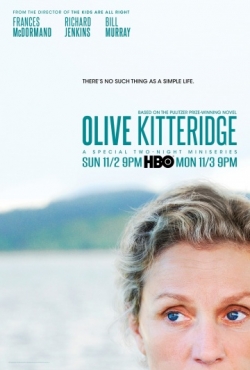 «Olive Kitteridge» is another book by Elizabeth Strout. It’s the one for which she won the Pulitzer Prize in 2009. The story of a woman I can only describe as a “terrible old hag” (for those interested, this term comes from Lyudmila Petranovskaya’s article “Generational Trauma”). A woman devoid of emotion, feeling, or joy. Grim and confidently carrying the bleakness of life. Her sharpness and callousness are what everyone—her husband, son, daughters-in-law, students, and neighbors—receive from her. But is she really as emotionless and cold as she appears at first glance? The book consists of 13 interconnected essays. Olive Kitteridge is not always the main character, but all these essays feel like a suite of rooms through which Olive moves with her family. They are like museum curators, showing us the lives of others—and through them, their own lives. And we, like tourists, move through and observe.
In 2014, the book was adapted into a miniseries titled «What You Know». The wonderful Frances McDormand played the lead role. And this is one of those rare cases where you should both watch the film and read the book. One does not replace the other.
And if we’re already talking about contemporary American writers and the Pulitzer Prize, I recently came across another author and book—a prize winner: Katherine Boo’s «Behind the Beautiful Forevers: Life, Death, and Hope in a Mumbai Undercity». Scant information available online states that Katherine Boo spent three years living in the slums of Mumbai to gather material for her book. She could just as easily have spent ten years there—or the rest of her life. And, most importantly, never written the book. Despite the wealth of material, the book is dull. The author gets bogged down in descriptions, at times even drowning in them. Every type of waste from Indian dumps is described in such detail that the book could serve as a user manual for someone who suddenly decides to become a waste sorter in Mumbai. The characters lack depth, the plot is disjointed, and the narrative jumps from one character to another, from one time period to another, without any parallels, introductions, or transitions—like a garbage collector rummaging through a dump. Reading it, you can’t help but feel sorry for such rich material. This is a prime example of how knowledge of material alone is not enough; a writer’s talent is essential. It’s comforting, though, that Katherine Boo did receive the Pulitzer Prize—not for the book itself, but for “service to society.”
Such different books and such different authors—read them, and you’re sure to find something that resonates with you.
Shpundra Elena
30.03.2015