

Hanna Vyshneva
Certified Psychotherapist · Clinical Psychologist
1 900 UAH
An imagery-based therapy using guided visualization to access emotions and unconscious material.
“The core technique of symboldrama involves the client visualizing images on a given topic while in a relaxed state. This method has proven highly effective in short-term therapy for neuroses, depression, fears, and psychosomatic disorders. It is used in individual sessions, couples therapy, and to improve parent-child relationships.
Since the unconscious mind operates through imagery rather than words, this approach allows for meaningful 'communication' with the subconscious. It helps express suppressed emotions (such as anger), release negative experiences (like resentment), forgive (for example, a parent), and resolve internal conflicts. The visualization unfolds as a journey through the 'landscapes of the soul,' where classic symboldrama symbols—linked to nature, archetypes, and life situations, needs, or conflicts—come to life.
After an initial discussion, the therapist guides the client, who is in a relaxed state (lying on a couch or sitting in a chair), to visualize a specific image. The duration of visualization depends on the patient’s age and the theme but typically lasts around 20 minutes. A full course of therapy usually spans 8 to 15 sessions, though significant improvements can emerge after just a few meetings—sometimes even a single session can alleviate a painful symptom or help resolve an urgent issue. Homework assignments, such as journaling and drawing the visualized images, are also common. Reviewing these records and drawings fosters conscious awareness of the experience.ВВалентина Юріївна Паробій
“Symboldrama is a journey you take with your therapist—one filled with joys and struggles, pleasant discoveries, and challenges. It mirrors life’s path, where each step makes you stronger, braver, and wiser. You learn to overcome difficulties, gain experience, and transform, emerging renewed—ready for a fuller, more meaningful life. This symboldrama course can last from a few sessions to several years, depending on your needs.
There’s also an express symboldrama therapy designed for a single session. It helps release tension, find a way out of a deadlock, restore self-confidence, and regain stability in life.
The method is recognized by the German healthcare system and is effectively used in therapy for cancer patients, prolonged depression, and other complex cases. The duration of therapy can range from one session to 2–2.5 years, depending on the depth of the issue and life circumstances.ЛЛеся Николаевна Яковлева
“I often work with imagery and metaphors, including elements of symbol drama. In my practice, I’ve seen clients who, by experiencing their issue as an image—often localized in the body—begin to explore it, ‘communicate’ with it, gain insights from it, and transform it for the better, sometimes even resolving it completely. This immediately improves their psychological state. Here’s an example from a session.
Client (C): My fear about how my boyfriend feels about me is like a dark, dense cloud—a thick disk.
Therapist (T): Where is it located?
C: Here (points to her chest).
T: How do you feel about this disk, this cloud?
C: Unpleasant. I can’t be myself… It’s like something is blocking me.
T: How would you feel without it?
C: (Pauses, her expression softens.) Much better. (Pause) I’d finally know he truly loves me… It’s not just my imagination.
T: What if you remove this disk?
C: Interesting. I should try.
T: Go ahead!
C: (Closes her eyes.) It’s in my hand now. I pulled it out—there was a black cord attached… To my heart. I pulled that out too.
T: How do you feel now?
C: Oh, so much lighter! The space feels free, and breathing is easier.
T: What will you do with it?
C: Burn it in a big furnace… It’s burning!
T: How does that feel now?
C: Easy. A sense of freedom has come over me.
T: Did this help you?
C: Yes, very much. I realized I was just afraid of someone else’s experience, but I have my own.
T: How do you feel about this fear now?
C: It’s gone… I feel calm and confident.ИИрина Алексеевна Селивановская
“Symbol drama, also known as catathymic-imaginative psychotherapy, can be understood as an emotional engagement with imagery akin to waking dreams. Unlike working with conscious fantasies, this method taps into the unconscious—a key distinction. While fantasies can be controlled, images (like dreams) arise spontaneously. Essentially, symbol drama allows individuals to revisit the past, recalling, analyzing, and—if needed—reimagining past experiences to gain new internal insights. Through discussion with the therapist and reflection, this experience is integrated into daily life. The process begins by guiding the patient into a relaxed state and inviting them to visualize a specific motif or freely chosen image. The patient shares their experiences with the therapist, who accompanies them, gently guiding the imagery as needed to align with the therapeutic strategy. Symbol drama therapists use over a hundred motifs, as well as recreations of real-life situations, to facilitate rapid and positive behavioral changes. A specialized branch, imaginative body-oriented psychotherapy developed by Dr. Leosh, focuses on treating complex somatic conditions (such as oncology, multiple sclerosis, and heart-related issues). Today, specialists in Ukraine already apply this method in practice.
“SymbolDrama is a modern method of psychotherapy with roots in ancient spiritual practices. The consultant guides the client into an altered state of consciousness—"daydreaming"—where the client explores their unconscious mind and actively interacts with it. The consultant accompanies the client in this state, using specialized knowledge and techniques. As a result of this work, emotional states change, neurotic symptoms weaken or disappear entirely, and insights emerge about how to resolve problematic situations. Consequently, life circumstances and life as a whole begin to transform.ЭЭмель Туаити
Certified Psychotherapist · Clinical Psychologist
1 900 UAH

Psychologist
1 700 UAH

Psychologist
1 400 UAH

Psychologist
900 UAH

Psychologist
3 600 UAH

Psychologist
1 000 UAH

Candidate Psychotherapist · Psychologist (Master)
1 000 UAH

Psychologist
750 UAH

Psychologist
500 UAH

Psychologist
2 000 UAH

Psychologist
950 UAH

Candidate Psychotherapist · Psychologist (Bachelor)
1 500 UAH
Psychologist
1 500 UAH
Psychologist
700 UAH

Psychologist
1 000 UAH

Psychologist

Psychologist

Psychologist
Psychologist
1 200 UAH

Psychologist
700 UAH
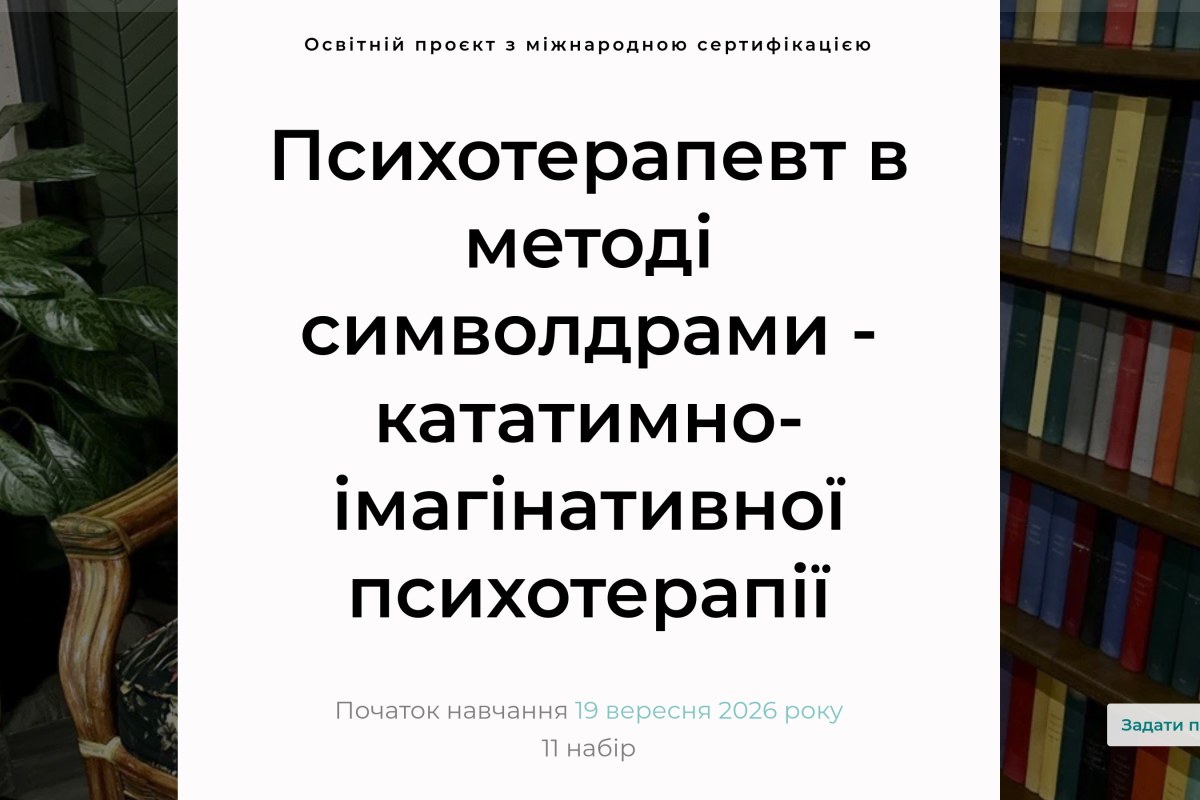
Organizer — Khmelnytskyi Branch of the Institute for Symbolic and Depth Psychology

Organizer — Дичеренко Юлія
Organizer — Лягущенко Ірина Віталіївна
Organizer — Левченко Дарина
Organizer — Викладач Лягущенко Ірина Віталіївна