



 I must warn you right away that this film is not cheerful—it’s quite dark, though more realistic than anything else. There’s nothing fantastical, nothing computerized, nothing retouched, nothing artificial, nothing unnatural. This raw realism is striking because synthetic everything is in vogue these days. Right now, reality is embellished, relationships are insincere, truth is concealed. Being agreeable to everyone is fashionable, standing out is not, raising your voice is not, saying unpleasant things is not…
But in this film, the masks come off.
The movie will definitely interest psychologists—like me—and anyone curious about the complexities of human relationships.
Now, a few words about the film itself.
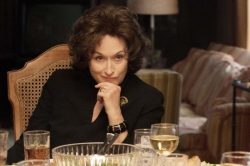
From the very beginning, what unsettled me was the fact that the protagonist, played by the incomparable Meryl Streep, is battling cancer—not just any cancer, but oral cancer. To me, this was a signal to ponder: What had gone unsaid in her life? What had been hidden all this time? What skeletons were locked away in the closet that led to such a grim fate?
And then, of course, it all began. The film explores parent-child relationships, where parents are dissatisfied with their children, believing they live wrongly and fail to appreciate what’s been done for them. It delves into romantic relationships, complete with infidelity, drugs, and alcohol—relationships where staying together is impossible, and being apart isn’t much better. It examines sibling bonds, including the weight of responsibility and caring for aging parents.
As I saw it, this film had it all.
There was the ailing mother, the alcoholic and suicidal father, relatives with deep secrets buried for decades—secrets that, once revealed, shattered already fragile relationships, though those relationships were doomed from the start. There were the sisters: one a perpetual failure who couldn’t find a man, constantly reminded by her own mother of her inadequacies and emotionally battered where it hurt most. Another was a naive dreamer convinced her partner loved her, while he openly pursued a 14-year-old relative. The third was a control freak who knew exactly how everyone should live—yet her own life was a mess… And at some point, they all had the chance to confront this bitter truth, to look it in the eye and see what it truly was.
The illusion faded, and the characters in the film were left facing unflattering reflections of themselves—both in relation to each other and, most importantly, in relation to their own selves. A person’s death became the catalyst for revelations no one welcomed, but there was no turning back the clock. Too much had been left unsaid for far too long. The silence had built up…