

"I love and I hate. Why do I do this, perhaps you ask? I don’t know, but I feel it happening and I am tormented."
Gaius Valerius Catullus (87–54 BCE)
«Я люблю і ненавиджу. Як це? Не знаю. Чую, що так воно є. Чую — і мучуся тим.»
Gaius Valerius Catullus (87–54 BCE)
(Translated by A. Sodomora)
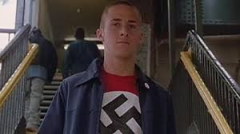
Film “Fanatik”
The film is based on a true story about a Ku Klux Klan member of Jewish descent.
The film begins with a quote: “I love and I hate. How is that? — you may ask. I don’t know. I feel it happening and I am tormented.” — which sets the tone for the entire movie.
We meet the protagonist, Danny. The story revolves around his inner conflict, which destructively impacts his entire life. Danny was raised in the Jewish faith, attended a Jewish school, but interpreted religious stories differently from most, leading to a conflict with his teacher. Later, he became the leader of a neo-Nazi group, opposing the Jewish faith and God.
Analysis of the Main Character
Childhood.
Danny, a Jewish boy, takes a rebellious stance in class when the teacher invites him to discuss the biblical story of the Binding of Isaac (description below), knowing Danny would likely have his own opinion. Danny expresses his view, but the teacher disapproves, and a conflict arises. The teacher threatens to expel Danny from class, publicly comparing him to apostates and worshippers of the Golden Calf. Danny reacts with the words: “Then let Him crush me right now.” After this, we see him descending the stairs, leaving the classroom. This moment is highly symbolic, as stairs also appear at the end of the film.
Key Conflict of the Main Character
According to the biblical account (Genesis 22:1–19), God tested Abraham’s faith by commanding him to sacrifice his beloved son Isaac as a burnt offering “in the land of Moriah” “on one of the mountains.” Abraham, without hesitation, obeyed. On the third day of their journey, Abraham and Isaac reached the designated place. There, Abraham “built an altar,” tied up Isaac (hence the traditional Jewish name for the story), “laid him on the altar over the wood,” and raised his knife to slay him (since a burnt offering to God required first being slaughtered and then burned), when an angel called out to him from heaven:
«Abraham! Abraham! <...> Do not lay a hand on the boy or do anything to him. Now I know that you fear God, because you have not withheld from me your son, your only son.» — Genesis 22:11–12
Instead of Isaac, a ram was sacrificed, and the Lord swore:
«I will surely bless you and make your descendants as numerous as the stars in the sky and as the sand on the seashore. Your descendants will take possession of the cities of their enemies, and through your offspring all nations on earth will be blessed, because you have obeyed me.» — Genesis 22:16–18
We can trace how the protagonist interprets this passage based on his words. Danny sees the Jewish God as arbitrary, intoxicated by power, and cruel. He refuses to serve a God who commanded Abraham to sacrifice his son. The boy also points out that Abraham had two sons, but was to kill his beloved one, concluding with the phrase: “They kill those they love.” The protagonist is convinced that God did not replace Isaac with a ram (there is a version of the story where no replacement occurred).
Significantly, as a neo-Nazi, during a beating of a Jewish youth, Danny says: “Damn Jew, do you think God will help you? Will He replace you with a ram?” This shows that the childhood incident did not pass Danny by; it remained ingrained in his mind and still partially controls him. The protagonist does not hate everyone around him but directs his focus specifically at Jews. Why? Let’s consider quotes describing his perception of the Jewish people. In childhood, he used such descriptions:
- Fear of God forces you to fear everything else;
- All Jews do is fear and sacrifice.
This suggests that Danny does not want to sacrifice or fear, which is why he needed to oppose God. When Danny, after his court sentence, attends mandatory group sessions with people who survived the genocide of Jews in Europe during World War II, he listens to their stories with a very emotional expression. This confirms that this topic is relevant to Danny. An elderly man recounts how a fascist brutally killed his three-year-old son in front of him. Danny’s personal trauma (the same one linked to the story of the Binding of Isaac) resurfaces, and he erupts with accusations toward the man:
“— What did you do? What did you do while the sergeant was killing your son?”
— What could he have done? — the man asks.
— What could he have done? He could have jumped on the sergeant and gouged out his eyes!
— But he would have been killed instantly!
— And now he’s worse than a corpse, he’s a piece of shit!”
The sergeant in the boy’s psyche represents the image of God, who demanded the sacrifice of a son, which is why Danny becomes so emotional and wishes the Jewish father had protected his son, even at the cost of his own life. We can hypothesize that Danny was traumatized in childhood in such a way that he feels like that unprotected child. His desire to be aggressively strong stems from a fear of being weak.
Manifestations of Ambivalent Feelings
On a conscious level, Danny expresses hatred for Jews, but when his group decides to bomb a synagogue, upon arriving there, he does not act like the other neo-Nazis. While his comrades mock Jewish religious symbols, Danny does not. Taking a book and approaching the altar, he says: “Shut up, get out.” Thus, the internal dialogue with the same God continues in the protagonist’s soul. God is real to him. Unlike his neo-Nazi comrades, he feels God’s presence and believes in Him but challenges His power and resists it. While the neo-Nazis mock the Torah, Danny tries to stop them and protect it, proving how seriously he takes Jewish traditions and symbols of his faith. Later, we learn he took the Torah home, cleaned it, and restored it after the neo-Nazis’ wild antics. At the same time, his intention to bomb the synagogue, the house of God, demonstrates his hatred and desire to destroy and defeat God.
Social Environment. The surrounding environment in which a person grows up is a crucial factor in shaping their personality. If we look at Danny’s family, he has a sister and a father. Throughout the film, there is no mention of his mother. His relationship with his sister is shown in a brief conversation where we learn that their father is ill and will soon die, and Danny sabotages his medication. The sister comments on Danny’s swastika T-shirt, saying, “How can you wear that? Don’t you know what it means for your people?” She insists that Danny have dinner with their father. During dinner, the father violates Jewish traditions and rules. It becomes clear where Danny got the ideas he expressed in Jewish school as a child. The conversation between them is cold; both look at the television rather than each other. The dialogue includes criticism of Jewish rules (indicating the topic that unites them) and a mention of a deceased uncle.
Danny has no friends, which may indicate loneliness and an inability to maintain friendships. His acquaintances from neo-Nazi activities are not close to him.
Throughout the film, Danny’s relationship with a young woman unfolds, but it lacks real intimacy. They are united by pain. The girl’s father is in a psychiatric hospital. After having sadomasochistic sex with Danny (which she initiated), she later has sex with her stepfather, knowing Danny will see it. Essentially, she provokes him. Despite this, their relationship with Danny continues. Once, when Danny asks her why she is with him instead of her stepfather, she replies: “Because of the sex, with you there’s more tragedy...” This suggests the girl’s need for tragedy, which Danny satisfies as he embodies an internal tragic conflict that she unconsciously senses.
At one point in the film, Danny begins to follow a Jewish family (father, son, mother, and a child in a stroller, possibly symbolizing the family he lost) as if hypnotized. He ends up in a bookstore in a Jewish neighborhood, where he meets a childhood friend from Jewish school. Danny lies that he is a businessman. The friend warmly invites him to services, and Danny attends, enjoying time among “his own people.” However, it is in this place that he later plants the bomb.
In one scene, Danny and another neo-Nazi go “hunting” for a Jew, but instead of killing the man, Danny wounds the neo-Nazi and flees. The wounded man, knowing that Danny wanted to kill a prominent Jew, kills the man himself and frames Danny. Danny’s childhood friend, now a prosecutor’s assistant, learns of the crime and tries to save Danny by falsifying evidence, saying: “I don’t care about the truth, but I care about you,” but he refuses to be saved. Instead, Danny intends to read a prayer in the church where he planted the bomb. According to his plan, he was supposed to be in the synagogue with a crowd of people during the explosion, but while reading the prayer, he changes his mind. He says what must happen, and the people leave the synagogue, but he stays. The penultimate frame shows a young boy in Jewish school again saying: “Then let Him destroy me right now!” This seems to return us to the original conflict, whose resolution ends fatally for Danny in the synagogue, where he destroys himself.
Thus, this film is a deep, multi-layered story about the inner conflict of a person who simultaneously loves and hates themselves, their people, their roots, and God. The struggle of opposing tendencies throughout his life exhausts him and leads to a tragic end.