


Yuliya Kalmykova
Psychologist
1 600 UAH
A structured approach analyzing communication patterns and ego states to improve relationships and self-awareness.
“Transactional Analysis is invaluable in situations where a person’s life follows a parental script. On paper, we map out ego states and use diagrams to analyze problematic situations, exploring various ways the patient might interact with significant others.ЕЕлена Георгиевна Максименко
“Transactional Analysis helps individuals gain deeper self-awareness. Within each of us exist three distinct 'ego states': the Child (our desires, needs, or reluctance to act), the Parent (the 'shoulds,' 'musts,' and 'must-nots'—the norms and rules that guide our lives), and the Adult, which seeks to reconcile the Child’s desires with the Parent’s directives. Often, clients struggle with internal conflict precisely because their Parent and Child cannot reach an agreement. For instance, a man may dream of becoming an artist, while his internal Parent insists he must earn substantial income and build a business. Alternatively, a woman may crave a break from responsibilities, but her internal Parent insists that only a bad mother would leave her children to relax. Such individuals suffer, unaware of how to break free from this vicious cycle.
During therapy, we learn to recognize these conflicts and explore what each ego state truly seeks. By analyzing genuine desires and needs—along with the 'parental' programs that hinder their fulfillment—we can find a balanced solution that resolves the inner contradiction. This fosters a sense of inner wholeness, freeing individuals from self-imposed struggles. Most importantly, it brings a renewed sense of joy and allows people to fully embrace life’s richness.
I recommend Transactional Analysis to those seeking a fresh perspective on their lives, those who wish to live authentically according to their true desires, and those who aspire to feel truly happy.
“Transactional Analysis is grounded in simple philosophical principles that emphasize human worth and potential. It operates on the premise that every person seeking help is fundamentally okay and does their best at any given moment based on their experience and available options. This approach is recommended for those who wish to gain deeper self-awareness, develop inner resources, and learn to manage their responses and interactions with others more effectively.ММария Фабричева
“Transactional Analysis is a straightforward yet profound method of engaging with clients by reconnecting them with their childhood perspective. Since most client concerns stem from experiences before age eight, therapy must create a safe space for the childlike part of the personality. Techniques used by transactional analysts—such as regression, reparenting, and redecision—directly reshape early decisions. Eric Berne’s core idea was to help clients resolve their issues in a single session. I invite you to explore this simple yet brilliant method of transforming your life together with me.
“Transactional Analysis (TA) offers a clear and accessible approach to understanding oneself and improving life. By gaining insight through TA, individuals can achieve their goals more effectively, foster healthier relationships, and nurture both their own well-being and that of others. Everyone deserves respect for their emotions, personal space, and the full range of their feelings—without harming others. TA provides the tools to embrace this. It’s one of the most compassionate methods in psychology, equally considerate of clients and therapists. TA clarifies causes and effects, unlocks new pathways, and reveals untapped resources. Working with this method is intuitive and rewarding—all it takes is the willingness to change.
“In summary, TA is a dynamic psychotherapeutic approach that integrates elements of CBT, psychoanalysis, Gestalt therapy, humanistic and existential therapy. Its strength lies in being accessible to anyone, regardless of profession or interests. Beyond psychotherapy, TA is a life philosophy applied in consulting, coaching, education, and organizations.ББогдан Власов
Psychologist
1 600 UAH

Clinical Psychologist · Candidate Psychotherapist · Psychologist (Master)
1 700 UAH

Candidate Psychotherapist · Psychologist (Master)
1 200 UAH

Psychologist
800 UAH

Psychologist
500 UAH

Psychologist
1 600 UAH

Psychologist

Psychologist
1 000 UAH

Psychologist
3 000 UAH

Psychologist
1 500 UAH

Candidate Psychotherapist · Psychologist (Master)
900 UAH
Psychologist
1 000 UAH

Psychologist (Master) · Psychologist (Bachelor)
1 200 UAH

Psychologist
700 UAH

Psychologist
2 500 UAH

Psychologist

Psychologist
800 UAH

Psychologist
500 UAH

Psychologist
1 500 UAH

Psychologist
600 UAH
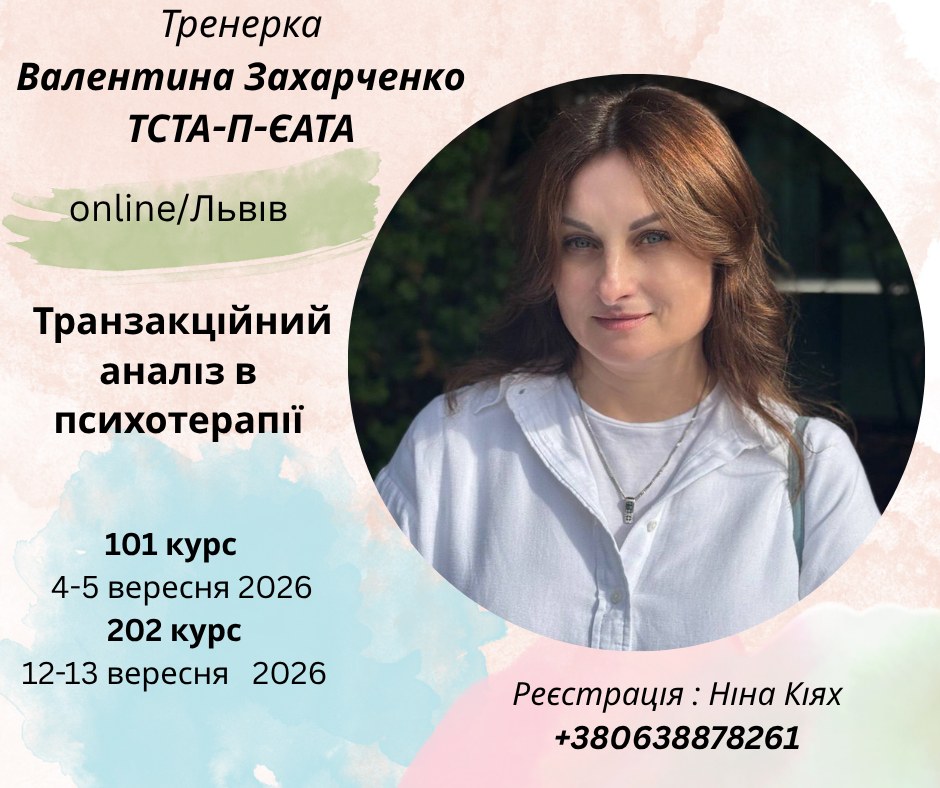
Organizer — Valentina Zakharchenko TSTA-p

Organizer — Viktoria Starchenko - PTCSTA-p, former trainer and supervisor, certified

Organizer — Катерина Шелест Сертифікований Транзакційний Аналітик, тренер та супервізор
Organizer — Катерина Шелест сертифікований транзакційний аналітик, тренер та супервізор
Organizer — Нехода Ірина
Organizer — Влада Березянська
Organizer — Влада Березянська
Organizer — Сашко Ангеліна
Organizer — Тетяна Гриценко, психотерапевтка в методі Транзакційного аналізу
Organizer — Психолог, психотерапевт, викладач англійської Олена Толокновська