


I would like to start with the title of the film. In the original, the film is called Nevidymy (Invisible), which is very different from the Russian adaptations Nespokoynaya voda (Troubled Water) or Mutnaya voda (Muddy Water). This translation from the English title Troubled Water seems, at first glance, more fitting to the film’s plot. In muddy or troubled water, underwater obstacles, depth, and potential dangers are not visible.
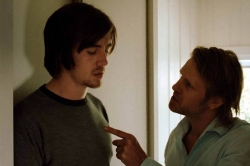 The plot is simple, and all events take place at the very beginning. Teenagers become guilty in the death of a child. This is not a premeditated murder. It is rather carelessness, unawareness, childishness. This is the very muddy water in which one’s own motives are invisible, the consequences are unforeseen, and there is only a flow of events.
The original title Nevidymy (Invisible) reflects the question of those forces—unseen forces both within a person and within life—that lead to catastrophe. If a misfortune occurs, it means we failed to see how we arrived at it or failed to see how to stop it. The invisible culprit in this film is guilt. The protagonist does not want to admit his guilt, and thus cannot seek forgiveness.
This film is about guilt, about whether redemption is possible, about overcoming grief, about forgiveness, and about returning to life in the present.
Guilt in the film is shown both from the perspective of the teenager, Yan, and from the perspective of the mother. While Yan suppresses his guilt—denying it—the mother of the deceased child is tormented by it. She is consumed by it, and this prevents her from living in the present, where she has two daughters who need her. The woman is too occupied with her grief and guilt, which only intensifies her suffering. She looks to the past and, as a result, withholds her warmth from her husband and children.
The young man also lives in the past. The film excellently illustrates how a traumatic event binds us to the past, how our inner world splits into two parts—one that lives in the past and another that tries to live in the present. The characters mentally return to the fateful day; the director shows how that day is replayed almost minute by minute. This is how trauma works—it pulls us back into the past as if it could become the present, as if it could be changed if we understood exactly which moment we should have returned to. This is what it means to not let go of a situation, a topic widely discussed in today’s articles. So what does it mean to let go?
To let go does not mean to forget or become indifferent. To let go means to accept, to come to terms with the past as it actually happened, not as it should have happened.
This happens toward the end of the film, when Yan and the mother of the deceased child return to that day together and relive it. Yan finally takes responsibility—he admits his guilt. He allows himself to feel guilt, to acknowledge it, and thus to repent. This, in turn, allows the mother of the deceased child to find peace. She strokes the killer of her son’s cheek, and in that gesture, one can sense, if not forgiveness, then at least acceptance.
Additionally, the film raises questions about the contradictions and complexity of human nature. We see a criminal who is released and takes a job as an organist in a church. Though Yan is hard to call a criminal, he is rather a lost teenager, an irresponsible boy who fears himself. The mother of the deceased child hears Yan playing in the church, and it stuns her—she cannot understand how a heinous murderer could play such beautiful music. Yan evokes similarly conflicting feelings in the viewer—should we condemn him or pity him? Perhaps neither. Maybe this is one of the hardest tasks: to acknowledge that there is no pure evil, just as there is no pure good. A person can be weak; a person can make mistakes. Sometimes, anyone can be swept up in the muddy water of various emotions, hidden motives, and desires. In this current, we can only try to reach the shore—that is, to become more mature and aware, to see the consequences of our actions, and to acknowledge our weaknesses, and thus our humanity.